Commercial Gym Equipment Specs That Actually Matter for High-Traffic Facilities: A Buyer's Technical Guide
Learn which commercial gym equipment specifications matter most, including motor ratings, frame strength, weld quality, bearings, cables, upholstery, load ratings, corrosion protection, and warranty c
1. “Light-Commercial” vs. “Full-Commercial” Is a Marketing Line, Not a Legal Standard
Light-commercial and full-commercial refer to manufacturer-defined product tiers, not globally regulated performance classes — which means the label alone tells a buyer nothing enforceable, and every RFQ should replace it with measurable specs.
The closest thing to a real international framework is ISO 20957, which sets general safety requirements, test methods, and classification systems for stationary training equipment used in hotels, clubs, schools, rehab centers, and studios, historically distinguishing S-class (studio/commercial), I-class (institutional), and H-class (home) usage [ISO]. But ISO 20957 doesn’t tell you what “full-commercial” means for a specific treadmill or rack — manufacturers define that themselves, inconsistently, across their own product lines.
Here’s where the real difference shows up in practice. Light-commercial gear typically targets a max user weight around 136–159 kg (300–350 lb) and treadmill motors rated around 3.0 continuous horsepower (CHP) — adequate for hotels, apartment gyms, and small offices where usage is intermittent. Full-commercial equipment for high-traffic clubs typically targets 181 kg (400 lb) user weight and 4.0 CHP or higher continuous-rated AC motors, paired with heavier-gauge steel at load-bearing points, sealed bearings instead of bushings, and formal preventive maintenance documentation [ISO; ASTM]. The gap between those two tiers isn’t cosmetic — it’s the difference between equipment that degrades gracefully and equipment that fails under sustained load.
ASTM F2276 adds a second layer, setting design and manufacturing requirements for equipment used by people 12 and older — covering stability, structural support, edges, pinch/shear/crush points, adjustment and locking mechanisms, and cable/belt/chain load-bearing parts, along with required installation and maintenance documentation [ASTM]. This standard applies regardless of whether a supplier calls their product light- or full-commercial.
Action tip: Strip “commercial” and “light-commercial” out of your RFQ language entirely. Replace them with explicit numeric requirements — max user weight, continuous motor rating, frame gauge, warranty terms — tied to your facility’s actual daily usage hours and peak concurrent users.
2. Treadmills Fail from Heat and Fatigue, Not from Lack of Peak Horsepower
Continuous duty horsepower (CHP) refers to the motor’s sustained power output under prolonged load, as opposed to peak horsepower, which only measures a short burst the motor can hit briefly — and CHP is the number that actually predicts whether a treadmill survives high-traffic use.
Peak HP numbers look impressive on a spec sheet, but they say almost nothing about how a motor performs after two hours of continuous running with heavy users at high inclines. A motor rated at “8 HP peak” might only sustain 3–4 CHP before thermal protection kicks in — and thermal shutdowns during peak gym hours are exactly the failure mode high-traffic facilities can’t tolerate.
Look at how manufacturers who publish transparent specs frame this distinction. One commercial treadmill line lists a 4 HP AC continuous-duty motor with 8 HP peak, alongside a 400 lb (181 kg) max user weight, a 22×60-inch belt, and a 15% max incline [Life Fitness]. A separate line aimed at lighter commercial use publishes a 3 HP continuous AC motor with a 350 lb (159 kg) max user weight and a 3-year commercial warranty [Precor]. A high-performance commercial line goes further, publishing a 5.0 HP AC drive system with a 400 lb (182 kg) max user rating [Matrix]. The pattern across all three: roughly 4–5 CHP and roughly 400 lb user capacity is the consistent range for equipment meant to run all day in a busy club — while 3 CHP and 350 lb is the consistent signature of lighter-duty product lines.
I once spent a Saturday afternoon walking three different budget gyms in the same metro area with a simple checklist — no clipboard theatrics, just my phone and a tape measure — checking which treadmills had visible belt slap, uneven deck wear, or motors that audibly strained on inclines above 8%. Every unit showing those symptoms was running a motor whose spec sheet, when I later pulled it up, only listed peak HP with no continuous rating disclosed anywhere. The units that ran quietly under load all had continuous-duty ratings printed on the console or in the owner’s manual. That’s not a scientific sample, but it matched exactly what the spec logic predicts: undisclosed continuous ratings correlate with equipment that struggles under sustained real-world load.
The opportunity side of this: buyers who insist on continuous-rating disclosure in the RFQ stage filter out a large share of underspecified suppliers before a purchase order is ever signed — this alone reduces early-life warranty claims.
Action tip: Never accept a treadmill spec sheet that lists only peak HP. Require continuous-duty rating, the test conditions it was measured under, and thermal-protection design, in writing, before quoting.
3. Strength Equipment Fails at the Weld, Not the Steel Tube
Frame integrity refers to the combined effect of steel gauge, tube geometry, weld quality, and gusset design at load-bearing joints — and it’s the weld and connection points, not the raw steel spec, that determine where high-cycle equipment actually breaks.
Full-commercial fixed strength machines commonly use 11-gauge structural steel tubing, with a nominal wall thickness around 3.05 mm [Legend Fitness]. But 11-gauge alone is not a quality guarantee — a poorly gusseted joint on thick tubing can fail before a well-engineered joint on thinner tubing. One manufacturer discloses 3×3-inch, 2×4-inch, and 3×2-inch 11-gauge tubing built to ASTM A500/A513 steel specs, with a 3.0–5.0 mil (76–127 μm) powder coat over iron-phosphate pretreatment [Legend Fitness] — a level of disclosure that’s rare and worth using as a benchmark question for other suppliers.
For power racks and squat stands specifically, heavier gauge is standard for a reason: one commercial rack publishes 4×4-inch, 7-gauge laser-cut steel uprights, rated for a 400 lb max user weight and a separate 900 lb max training load [Matrix Fitness]. That distinction — user weight rated separately from training load — is the single most important line item buyers miss. A rack rated for a 400 lb user isn’t automatically rated to hold 900 lb of barbell load; those are two different engineering questions, and any supplier who conflates them in a single number should be pushed for clarification.
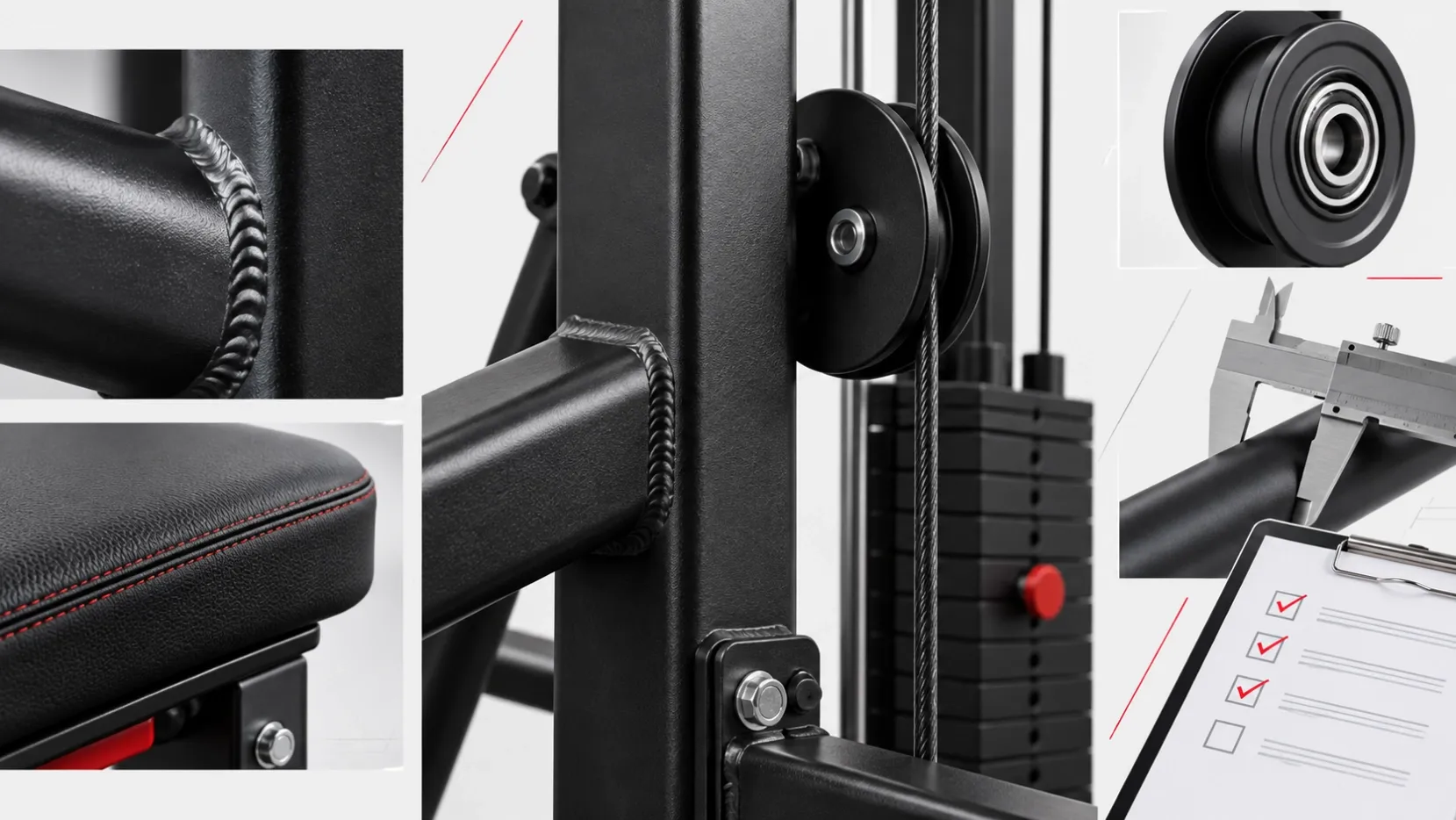
Weld quality is harder to verify from a spec sheet, which is exactly why it gets skipped in most RFQs — but it shouldn’t be. Critical welds sit at the upright-to-base junction, cross-member connections, cantilever supports, weight-stack towers, and barbell hook mounts. Visible cracks, undercut, porosity, weld overlap, uncontrolled spatter, or coating that hides a defective seam are all reasons to reject a unit at inspection, not after installation [Legend Fitness]. One manufacturer specifically cites shielded MIG welding referencing AWS structural welding codes [Legend Fitness] — but a citation to a welding code isn’t the same as traceable inspection records, and buyers should ask for the latter regardless of which code gets referenced.
Action tip: Require separate written ratings for max user weight and max training load on every rack, bench, and multi-station machine — and ask for weld inspection documentation (not just a welding process description) before accepting delivery.
4. Bearings, Cables, and Upholstery Are Where Total Cost of Ownership Actually Lives
Wear-interface components refer to the moving parts — pivots, pulleys, cables, bushings, and upholstery — that see the highest cycle counts in the entire machine, and they’re the parts that decide maintenance cost long after the frame and motor have proven reliable.
High-cycle pivot points and pulleys on full-commercial strength equipment should use sealed bearings, or proven self-lubricating bushings on guide rods, to reduce sweat and dust ingress and extend smooth operation [Precor]. One line specifically markets sealed bearings at all pivot points combined with chrome-plated adjustment plates as a durability feature [Precor] — the underlying engineering point (sealed vs. open bearings at high-cycle joints) is the transferable lesson, regardless of which supplier discloses it.
Cable systems deserve their own line item. A 7×19 lubricated, nylon-coated aircraft cable is a common configuration in full-commercial selectorized and functional trainers, but “7×19” alone is not sufficient specification — diameter, minimum breaking strength, termination method, and actual pulley routing all affect real-world fatigue life. One published spec lists 7×19 aircraft cable at 3,100 lb minimum breaking strength [Legend Fitness]; another discloses cables meeting U.S. military specification with sealed-bearing pulleys and self-lubricating bushings on weight guide rods [Hammer Strength]. What matters for a buyer isn’t which brand states this — it’s confirming the actual working tension, pulley ratio, termination integrity, and bend radius on the specific unit being quoted.
Upholstery abrasion resistance is measured in Wyzenbeek double rubs under ASTM D4157 — one pass back and forth counts as one double rub, and higher counts generally indicate better resistance to repeated friction, though the number doesn’t capture tear resistance, chemical resistance, or seam strength on its own [Michael Jon Designs; Sailrite]. A practical benchmark: 30,000 double rubs for light-commercial upholstery, at least 50,000 for full-commercial, and 100,000+ for high-contact surfaces like bench pads and seated row pads in heavy-traffic clubs [BFM Seating; FibreGuard]. Note that Wyzenbeek and Martindale are different test systems and their numbers should never be directly compared or converted [FibreGuard].
I’ve made a habit, when visiting client facilities, of running my thumbnail along bench pad seams and checking for cracking at the fold lines — it takes ten seconds and tells you more about upholstery quality than any brochure claim. Pads that crack first at the seam almost always trace back to either low double-rub ratings or foam that’s already lost compression set, and both are things a buyer could have caught in the spec sheet before purchase, not after eighteen months of use.
Corrosion resistance rounds out this category. Indoor equipment corrodes too — sweat salts, damp towels, floor cleaning, and disinfectant residue attack welds, holes, tube ends, and fasteners. A disclosed benchmark of iron-phosphate pretreatment with 3.0–5.0 mil (76–127 μm) powder coat [Legend Fitness] is a reasonable reference point; general industry guidance suggests roughly 80–120 μm coating thickness with phosphate pretreatment and at least 500 hours of neutral salt spray performance as a useful starting requirement, tested under ASTM B117 or ISO 9227, though acceptance criteria should also specify corrosion creep at scratch points and blistering thresholds, not just pass/fail hours [Sundial Powder Coating].
Action tip: Build a maintenance-based acceptance test into your PO: run your thumbnail along seam lines, inspect cable terminations for fraying or flattening, and confirm bearing type (sealed vs. open) at every high-cycle pivot — before signing off on delivery, not during month-six maintenance.
5. Load Ratings and Warranty Terms Are Where Buyers Get Burned Months Later
Load rating disclosure refers to separately stating every category of weight or force a machine is rated to handle — user weight, training load, weight-stack load, barbell load, storage load, and dynamic/impact load — because collapsing these into one number is the single most common way commercial buyers get an unpleasant surprise after installation.
These categories are genuinely distinct: max user weight covers the person standing, sitting, or moving on the equipment; max training load covers external resistance like barbell weight on a squat rack; weight-stack load covers the selectorized plates themselves; max barbell load covers what a J-cup, safety arm, or bench rack can hold; storage load covers plate trees and dumbbell racks; and dynamic/impact load covers the transient forces from dropped barbells, users landing, or swinging movements, which routinely exceed static weight ratings and are the most common cause of fatigue failure at connection points. The rack example from earlier — 400 lb user rating paired with a separately stated 900 lb training load [Matrix Fitness] — is the model to insist on from every strength-equipment supplier.
Warranty terms need the same disaggregation. “Ten-year frame warranty” sounds reassuring until you realize it says nothing about the motor, cables, bearings, upholstery, or console — the components that actually fail first. A defensible warranty breakdown separates frame/weld coverage, motor/controller/deck/belt/roller coverage on cardio equipment, cable/pulley/guide-rod/pin coverage on strength equipment, upholstery/foam/seam coverage, and console/electronics coverage — plus parts, labor, on-site service, and response time commitments, with explicit exclusions for corrosion, cleaning-chemical damage, misuse, and unauthorized repairs [Precor]. Recommended preventive maintenance — monthly inspection of visible welds, frames, cable connections, cable and terminal wear, cable tension, pads, and adjustment pins — is a documented industry practice, and it means long-term reliability is jointly determined by original build quality and whether that maintenance schedule actually gets followed [Precor].
Action tip: Require your supplier to itemize warranty coverage by component category — not just “frame” and “everything else” — and get spare-parts availability commitments in writing, including a minimum post-discontinuation parts-supply period.
Conclusion
The most decisive commercial gym equipment specs aren’t the ones printed largest on a brochure. They’re continuous-duty motor rating (not peak HP), frame gauge and weld quality at load-bearing joints (not “heavy-duty steel” as a phrase), bearing type at high-cycle pivots, cable specification with actual breaking strength, upholstery abrasion rating tied to a named test method, corrosion pretreatment and coating thickness, and — critically — load ratings and warranty terms broken out by component rather than bundled into one reassuring number. Manufacturers who disclose this level of detail voluntarily [Life Fitness; Precor; Matrix Fitness; Legend Fitness; Hammer Strength] are showing you what a complete spec sheet should look like — use that as your baseline questionnaire for every supplier you evaluate, regardless of brand.
FAQ
Q: Is a heavier treadmill always better built than a lighter one? A: Not necessarily. Higher overall weight often correlates with a larger frame, deck, roller, or drive system, but it isn’t proof of quality on its own — always verify continuous motor rating and structural specs directly rather than inferring quality from shipping weight.
Q: Can I directly compare Wyzenbeek and Martindale abrasion test results? A: No. They’re different test methodologies with different mechanics, and their double-rub or cycle counts shouldn’t be converted or compared directly — ask suppliers which test method was used and evaluate within that system only . Q: What’s the single most common spec-sheet omission that causes problems later? A: Motors listed with only peak horsepower and no continuous-duty rating. This omission is common precisely because peak numbers look better on paper, but it hides the thermal performance that actually predicts treadmill reliability under sustained high-traffic use.
Q: Does a longer warranty period always mean better equipment? A: Not by itself. A long warranty on the frame alone tells you nothing about motor, cable, bearing, or upholstery coverage — request a component-by-component warranty breakdown before treating warranty length as a quality signal.
Q: How often should high-traffic equipment be inspected once installed? A: A monthly inspection cycle covering visible welds, frame condition, cable connections and terminal wear, cable tension, upholstery condition, and adjustment pins is a commonly cited baseline for commercial facilities — high-usage locations may need to inspect more frequently.
Q: Is 11-gauge steel always sufficient for strength equipment? A: It’s a reasonable general-frame benchmark, but load-bearing points on racks, uprights, and barbell contact zones commonly use heavier 7-gauge steel or equivalent reinforcement — gauge alone also doesn’t account for joint design, gussets, or weld quality, all of which need separate verification.
Choose Commercial Equipment With Confidence
Need help comparing commercial strength, cardio, and functional training equipment specifications? Discuss your project requirements with ZOYI FITNESS.
Get a Commercial Quote