What Global Buyers Actually Pay for Commercial Gym Equipment (And Why the Sticker Price Is the Wrong Number to Compare)
Learn how to compare commercial gym equipment prices using total landed cost, regional pricing, specifications, certification, order volume, freight, Incoterms, currency risk, and detailed RFQs.
If you’ve ever put out an RFQ for a batch of treadmills or a functional training rig and gotten back three quotes that look nothing alike, you already know the problem: there is no single “market price” for commercial fitness equipment. A factory in Ningbo, a dealer in Ohio, and a distributor in Dubai can all quote the same rack and land on numbers that differ by 3x — and none of them are lying. They’re just answering different questions. This article breaks down what actually drives the number on the quote, region by region and cost driver by cost driver, so you can compare apples to apples instead of getting burned by a low headline price that turns into a high total cost.
1. Total Landed Cost Is the Only Number Worth Comparing
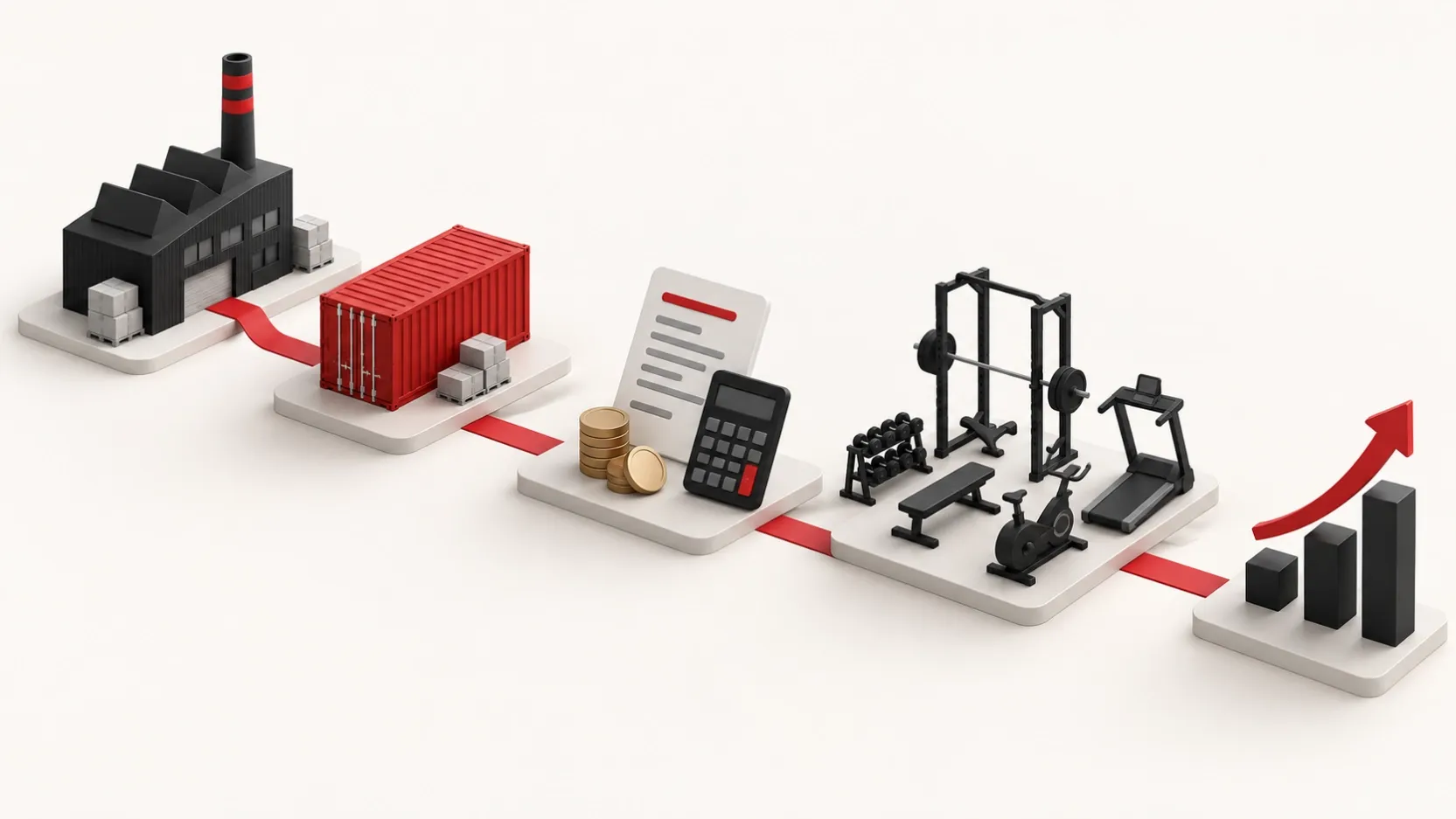
Total landed cost is defined as the full price of getting a piece of equipment from the factory floor to an operating, installed, warrantied station on your gym floor — not the number printed on a supplier’s price list. That means equipment price plus export packaging, origin port charges, international freight, insurance, import duty, destination VAT/GST exposure, customs clearance, inland transport, installation, and commissioning [CoreHandF]. Skip any one of these and you’re not comparing quotes — you’re comparing fragments of quotes.
The category-level numbers make this obvious. A Chinese-factory commercial treadmill might run $1,500–$5,000, a mid-tier unit $5,000–$9,000, and a premium brand $9,000–$22,000+ [PowerGymEquip] [CoreHandF]. But those brackets already assume different scopes — some are EXW factory prices, others are dealer project prices with installation baked in. On the branded end, the numbers are at least verifiable: Life Fitness lists its Hammer Strength HD Tread at roughly $9,467, and Technogym’s US site prices treadmills from about $5,130 to $21,990 [Life Fitness] [Technogym]. Neither of those figures tells you what a bulk hotel-chain order would actually cost after negotiation, but they anchor the top of the range in something you can check yourself, which is more than you can say for most factory quotes floating around B2B marketplaces.
Here’s the dialectical part: a lower landed cost isn’t automatically the better deal, and a higher one isn’t automatically safer. A buyer with in-house import experience, a freight forwarder relationship, and quality-control capacity can turn a low EXW quote into a genuinely low landed cost. A buyer without that infrastructure will bleed the savings back out in customs delays, damaged freight, and equipment that shows up without the accessories they assumed were included. The opportunity here is real cost arbitrage for buyers who can manage the logistics themselves; the risk is treating a factory-direct price as if it were a finished, installed cost.
Action: Before comparing any two quotes, normalize them to the same landed-cost basis — ask every bidder for EXW, FOB, and DAP pricing on the identical spec sheet, so you’re comparing scope, not just numbers.
2. Regional Price Structures Reflect Different Risk Allocations, Not Just Different Markets
A regional price structure is defined as the combination of distribution layers, regulatory obligations, and service expectations that a given market bakes into its quotes — which is why the same equipment costs different amounts in different regions even before freight is added.
In North America, procurement usually runs through brand dealers, gym-project integrators, regional distributors, or direct import from China [Technogym] [Strength Warehouse USA]. The premium in a North American dealer quote pays for warehousing, spare parts stock, warranty labor, and installation crews — real costs that reduce downtime risk for a hotel or corporate gym, but costs nonetheless [Jerai Fitness]. In Europe, the gap between factory price and landed price widens further because CE compliance responsibility, EN ISO 20957 testing, technical documentation, and multilingual labeling are legal obligations, not optional service add-ons [ComplianceGate] [EUR-Lex]. A cheap European quote that can’t produce a model-specific EU Declaration of Conformity is not actually cheap — it’s a liability you haven’t priced yet.
The Middle East splits along a different axis entirely: hospitality and government projects lean toward international brands with full service contracts, while independent gyms often import directly from China [PowerGymEquip]. What changes the price here isn’t brand prestige so much as environmental engineering — corrosion protection, powder-coat specification, and controller heat tolerance for high-temperature, high-humidity installations [Light In Fitness]. Asia-Pacific is even less uniform: Southeast Asian markets close to Chinese manufacturing hubs get a freight advantage that Australia, New Zealand, Japan, and Korea simply don’t have, because their landed costs carry longer sea legs and higher local certification and service overhead [DDPChain] [Freightos].
I ran a small version of this comparison myself: I sent an identical spec sheet for a 10-station functional trainer to a Chinese export factory, a European-market distributor, and a North American dealer, asking each for EXW/FOB, CIF, and DAP pricing on the same configuration. The factory’s EXW number was roughly a third of the North American dealer’s installed price — but once I added freight, EU compliance documentation fees the factory couldn’t provide, and installation the dealer already included, the actual gap closed to something closer to 40–50%, not 200%. The lesson wasn’t “China is cheap” or “dealers are overpriced” — it was that nobody was quoting the same thing until I forced them to.
Action: Don’t let “region” become a shorthand for “price tier” in your sourcing decisions — request the same three-tier quote (EXW/FOB/CIF/DAP) from at least one supplier in each region you’re evaluating, and let the landed numbers do the comparing.
3. Specification, Certification, and Order Volume Move the Price More Than Brand Name Does
A cost driver, in procurement terms, is defined as any variable in the spec sheet or order structure that changes unit price independent of the supplier’s brand positioning — and for gym equipment, three of these matter more than most buyers assume: build specification, regulatory compliance, and order quantity.
On specification, “commercial grade” is not a standardized performance definition anywhere in the world. Two treadmills both marketed as commercial can differ substantially in continuous-duty motor rating, deck and belt construction, roller diameter, maximum user weight, and control-board reliability [CoreHandF] [Light In Fitness]. For strength equipment, price is driven by tube gauge and steel grade, welding quality, powder-coat pretreatment, bearing and pulley quality, and cable specification [PowerGymEquip]. None of that shows up in a one-line price comparison, which is exactly why low-ball quotes on functional racks and squat stands are so common — the supplier simply spec’d a lighter tube wall or dropped the anchoring hardware.
On certification, the cost isn’t the badge — it’s the testing and documentation behind it. EN ISO 20957 sets the general safety requirements and test methods for indoor fixed training equipment sold into the EU, with different parts covering treadmills, bikes, and strength machines [ISO]. Buyers should confirm the usage class a machine is rated for — Class S for gyms, hotels, and public facilities versus Class H for home use — rather than accepting a vague “commercial” label [Light In Fitness]. A supplier who can’t produce a model-specific EU Declaration of Conformity and third-party test report isn’t offering a discount; they’re offering unquantified regulatory risk that lands on you, the importer of record [ComplianceGate] [EUR-Lex].
On volume, unit economics shift meaningfully at the container level. Sample or 1–5 unit orders carry the highest per-unit price; a full 20-foot or 40-foot container typically unlocks a materially better FOB rate and packaging efficiency, and a standing annual order can unlock spare-parts programs and private-label packaging [PowerGymEquip] [DDPChain]. Private-label and custom projects also carry one-time costs — tooling, printed packaging, translated manuals, certification testing — that should be quoted separately from the per-unit price, not buried inside it [CoreHandF].
Action: Require suppliers to itemize their quote by specification tier, certification status, and volume break — a single blended number hides exactly the variables you need to negotiate on.
4. Freight, Incoterms, and Currency Exposure Can Erase a Factory-Price Advantage
Cross-border freight exposure is defined as the portion of total cost created by shipping method, trade terms, and exchange-rate movement between quotation and delivery — and for gym equipment, this exposure is unusually large because the category spans very heavy, low-value steel products and lighter, high-value electronic ones.
For barbells, plates, dumbbells, and racks — heavy, dense, comparatively low value-per-kilo — freight can consume a large share of any factory-price advantage, especially on LCL or partial-container shipments [AEB Logistics] [DDPChain]. For electronic cardio equipment, the value density is higher, so freight is easier to absorb, but the exposure shifts toward shipping damage and post-sale electronic component support instead [DDPChain]. Current container-rate references illustrate the volatility rather than a stable baseline: one 2026 index shows spot 40-foot rates ranging broadly from roughly $2,500 to $10,000 depending on lane and timing, with Shanghai–New York around $3,671/FEU and Shanghai–Rotterdam around $2,308/FEU at specific points in time [FreightAmigo]. A separate 2026 estimate puts China-to-North America 40-foot containers around $2,500–$3,400, to Europe around $2,300–$3,200, to the Middle East around $2,100–$2,800, and to major Asian markets around $2,000–$2,600 [DDPChain] — all before trucking, customs, port handling, and destination charges.
Incoterms decide who absorbs which piece of that exposure. EXW puts nearly everything — export clearance, freight, insurance, import duty, inland delivery — on the buyer, which is why it looks cheapest and isn’t necessarily the most useful basis for comparison. FOB is a more workable benchmark for container-load sourcing because the seller handles export formalities and loading, while the buyer controls the ocean leg. DAP and DDP shift more risk to the seller but require the buyer to verify exactly what “delivered” means — is unloading included, is there a named address, is the importer of record clearly assigned [Freightos] [DDPChain]. Every Incoterm reference in a quote needs a named location — “FOB Ningbo Port,” not just “FOB” — or the term is functionally meaningless.
Currency exposure compounds all of this. A Chinese factory quoting in USD is still paying for steel, labor, and overhead in RMB, so exchange-rate swings tend to surface as shortened quote validity, canceled discounts, or raw-material surcharges rather than an explicit line item [IndexBox]. European suppliers quoting in EUR or GBP pass exchange exposure to USD buyers directly, and Middle Eastern or Asia-Pacific buyers can end up mismatched between USD-denominated import costs and local-currency revenue [Freightos].
Action: Ask every supplier to state quote currency, exchange-rate assumptions, quote validity period, and any raw-material or freight surcharge clauses in writing — an unstated currency assumption is a hidden price increase waiting to happen.
5. A Well-Built RFQ Converts Vendor Estimates Into Enforceable Commitments
An enforceable RFQ is defined as a request for quotation detailed enough that a supplier’s response becomes a specific, comparable, and contractually binding commitment — rather than a marketing estimate you discover the limits of after the container has shipped.
Most of the pricing ranges circulating in this industry are exactly that: estimates. Full commercial free-weight areas are commonly modeled at $10,000–$40,000+, complete selectorized-circuit areas at $25,000–$80,000+, and functional-training rig zones at $5,000–$25,000+ in public budgeting guides [CoreHandF] — useful for early-stage planning, useless as a number to hold a supplier to. The gap between planning-stage estimate and binding quote is closed by specificity: model numbers, load ratings, steel specification, welding process, coating system, motor duty rating, voltage and plug configuration, applicable regulatory standard, and model-specific test reports [Jerai Fitness] [Light In Fitness]. An RFQ should also force suppliers to separate one-time costs — tooling, private-label fees, certification testing, sample charges — from recurring per-unit price, and to quote EXW, FOB, and DAP/DDP on identical, named-location terms so nothing gets hidden in an ambiguous “delivered” line [PowerGymEquip] [ComplianceGate].
A workable template looks like this: “Please quote for 20 units of commercial motorized treadmills for a hotel gym project. Provide separate pricing on EXW, FOB Ningbo, and DAP Los Angeles basis. State continuous-duty motor specification, running-surface dimensions, maximum user weight, machine net/gross weight, console configuration, 120V/60Hz electrical version, commercial warranty by component, EN ISO 20957 test-report reference, CE/EU Declaration of Conformity where applicable, packaging dimensions, container loading quantity, critical spare-parts kit, lead time, MOQ, private-label options, payment terms, and quotation validity. Please also quote quantities of 1, 20, and 100 units separately.” For strength racks and free weights specifically, never accept a single “per set” price — force a breakdown by main frame, uprights, crossmembers, attachments, plates, storage, anchoring hardware, packaging, freight, and installation, or a supplier can quietly hollow out the spec to hit your target number [CoreHandF] [PowerGymEquip].
Action: Build one standard RFQ template with every variable above as a mandatory field, and reject any quote that leaves a field blank — a supplier unwilling to itemize is a supplier unwilling to be held to the number.
FAQ
Q: Is a lower factory-direct price from China always the better deal for commercial gym equipment? A: Not automatically. For steel-heavy products like racks and free weights, freight and import handling can erase much of the factory-price advantage, and buyers still need to manage quality control, certification, and warranty support themselves. It’s the better deal specifically for buyers who can absorb that logistics and QC workload.
Q: What’s the real difference between a “commercial” and a “home use” rating on the same-looking machine? A: In markets that follow EN ISO 20957, machines are rated by usage class — Class H for home use versus Class S for gyms, hotels, and public facilities — with different durability and safety testing behind each rating. A machine without a model-specific test report for the class you need isn’t verified for commercial use regardless of what the listing calls it
Q: Why do two suppliers quote wildly different prices for what looks like the identical squat rack? A: Usually tube gauge, steel grade, welding process, coating system, and whether anchoring hardware and attachments are included — none of which show up in a one-line “price per rack” comparison.
Q: Which Incoterm should I use to compare quotes across multiple suppliers? A: FOB at a named port is generally the most practical benchmark for container-load sourcing, since it isolates the equipment and export-handling cost from the ocean freight leg, which you can then price separately and compare across suppliers.
Q: How much should I budget for ocean freight when comparing landed costs? A: Treat any published rate as a reference point, not a quote — 2026 estimates for 40-foot containers from China range roughly $2,000–$3,400 depending on destination region, before customs, port charges, and inland delivery are added.
Q: What single document should I always request to verify a supplier’s compliance claim? A: A model-specific test report and, for EU-bound equipment, a signed EU Declaration of Conformity referencing the applicable EN ISO 20957 part — a certificate photo or a general company-level claim is not sufficient verification.
Plan Your Commercial Gym Equipment Project
Looking for commercial-grade strength, cardio, free-weight, or functional training equipment? Discuss your project requirements with ZOYI FITNESS.
Get a Commercial Quote